
“Contracts written for monopoly logic run the risk of destroying value in competitive markets. The new landscape demands a move away from legacy and towards commercial common sense.” – Alayne Meinesz, Caveat Energy Specialist.
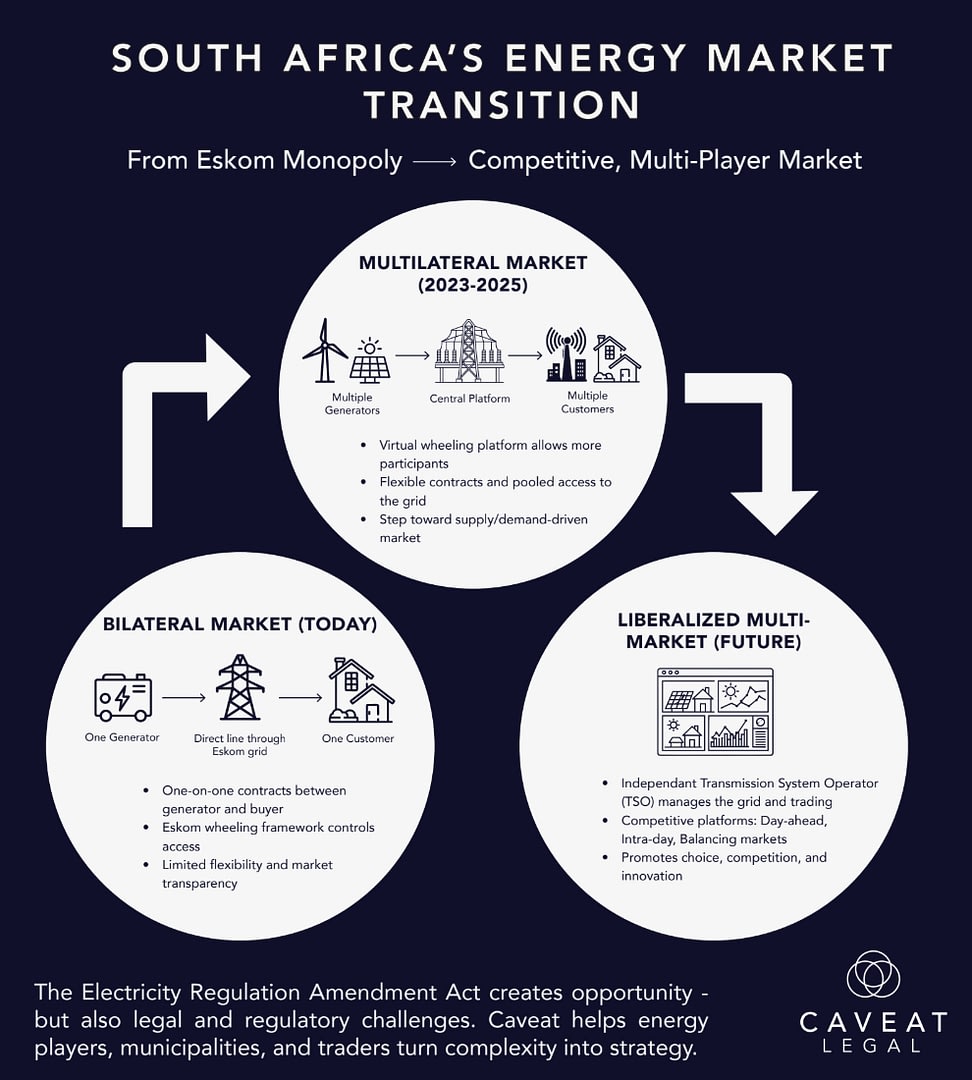
South Africa’s electricity market is set to shift from a centralised, single-buyer model to a competitive multi-market platform that allows for an independent transmission system operator, central purchasing agency, and ultimately increased room for traders to price risk. That’s a once-in-a-generation chance to reset your economics. That is – if your contracting, procurement, and operational assumptions keep pace with the rules of the game.
Here’s what we’re seeing on transactions across IPPs, traders, municipalities, and large offtakers:
- Contracts built for the old world can quietly destroy value in the new.
Legacy PPA templates still assume a buyer with monopoly characteristics, vertically integrated roles, and blunt curtailment logic. In a more competitive landscape – which we’re seeing now – those assumptions create mispriced risk. Curtailment, imbalance, and credit are no longer backend schedules, they’re the economic engine driving the enterprise. If your PPA doesn’t allocate, for example, curtailment and imbalance risk transparently – and map it to trader capability, credit enhancement provisions, and clear settlement mechanics to manage the financial impact – you’ll carry volatility that your financing and insurance can’t easily clean up. - Traders are the new system integrators – and your clauses must let them do their work.
The best traders these days are building portfolios across technologies, locations and counterparties. To extract that value effectively, your contracts will need to allow for netting, accurate demand forecasting, data-sharing, and real-time balancing action. The more your documents lock a trader into outdated “Eskom-era” rigidity, the less they can do. And that will likely show up in the price they quote you. - Wheeling is no longer a “bonus” – it’s the highway.
Corporates and municipalities want renewables without the burden of owning generation. Ideally, that means wheeling-ready arrangements where the physical and financial flows match – and the paperwork does too. We start every wheeling conversation by carefully mapping out roles and settlement flows on a single page: who invoices whom, for what, and on what input data. The reality is – if you can’t show that answer cleanly, you’ll bleed in operations. - Municipalities need procurement that can sprint, not crawl.
Let’s be blunt – tenders written for a monopoly era simply don’t transact competitively. Municipal SCM frameworks must be modernised in order to handle market-based procurement, trader qualification, and PPA award under a new procurement regime. The prize is huge: diversified supply and better tariff trajectories without governance compromises. The risk is also real: move too fast on the wrong legal scaffolding and you invite failed procurement and audit pain.
A practical, not theoretical, checklist:
- Re-paper PPAs for competitive risk: explicit imbalance allocation; robust curtailment logic; performance obligations that match trader capability; bankable credit architecture.
- Make your offtake “trader-ready”: flexible delivery windows, metering and data rights, and dispute processes that don’t freeze operations.
- Wheel with clarity: a single flow diagram covering energy, network charges, losses, and cash.
- Municipal SCM tune-up: align to a new pupose-built procurement regime; train internal teams and pilot with qualified traders.
Our job is to design contracts that let capital, electrons, and cash move cleanly through a market that finally rewards efficiency. If you’re still negotiating Eskom-era clauses, you’re paying for risk you don’t need – and missing upside your competitors will happily take. Let’s talk.
